

Spelling Bee archive rules and the required center letter
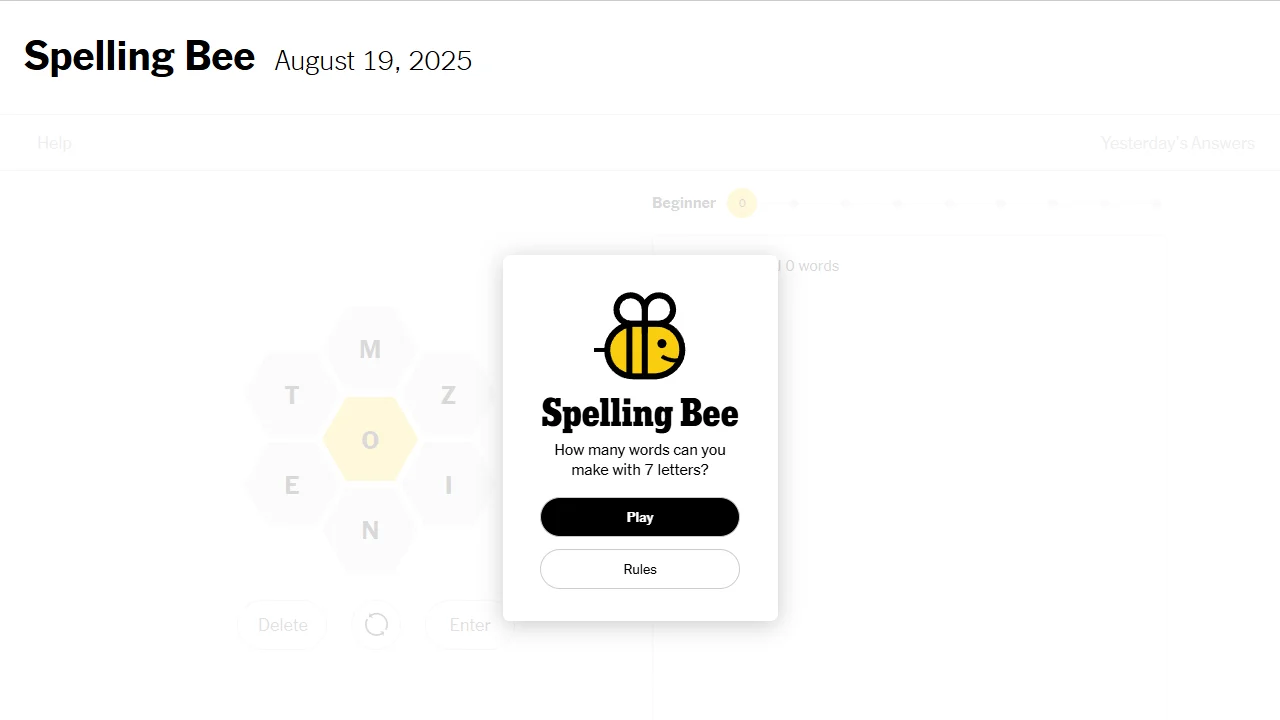
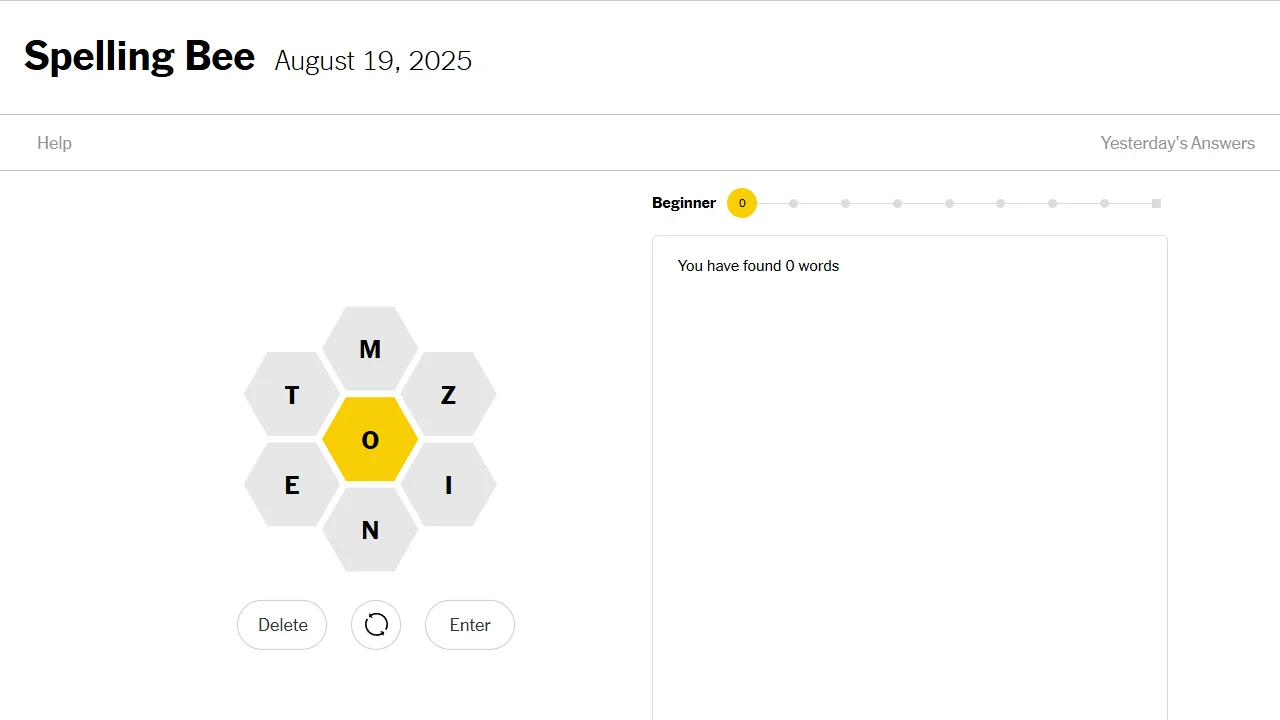
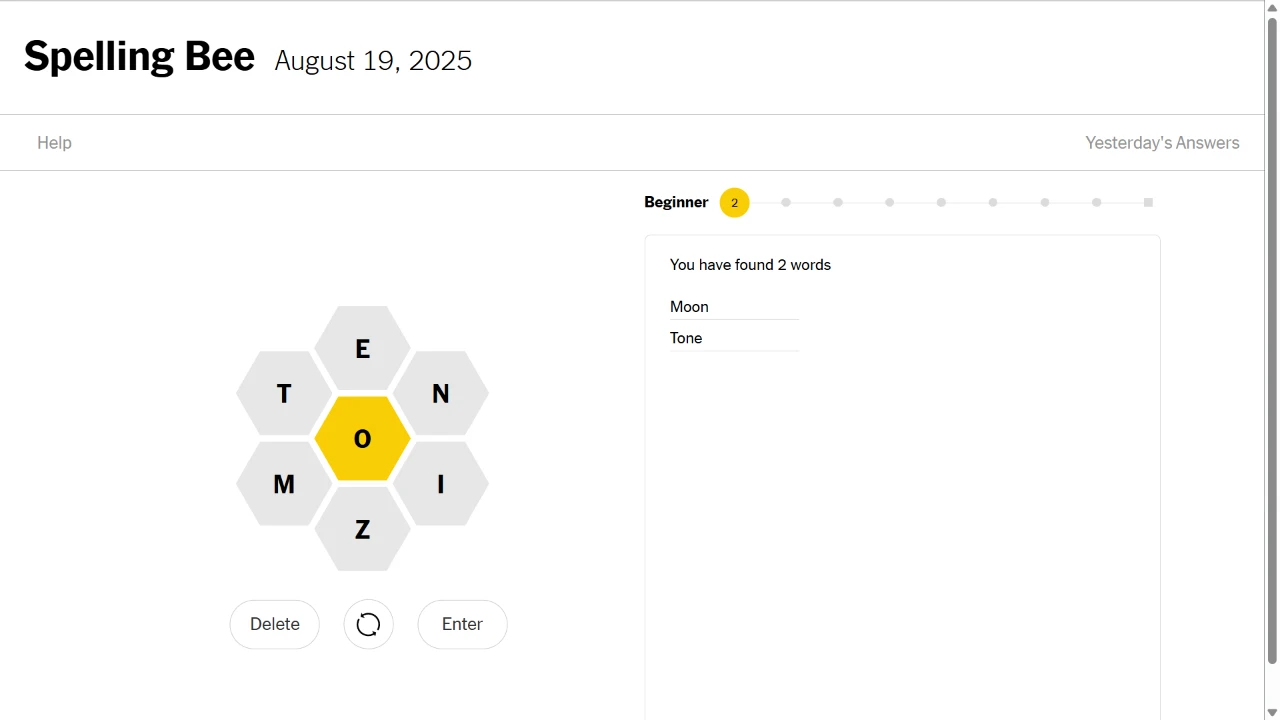
Spelling Bee gives us seven letters arranged around a hive. Every accepted word must include the center letter, may reuse letters, and must be at least four letters long. A pangram uses all seven available letters and is the most valuable discovery. The important version note is visible inside this build: the AZGames page shows an archived puzzle dated August 19, 2025. We therefore treat it as a stable practice snapshot, not as a promise of a newly updated daily challenge. That limitation is actually helpful for strategy work because we can test word families and scoring ideas against the same letter set.
| Rule or score event | Effect | Player check |
|---|---|---|
| Center letter | Must appear at least once in every accepted word | Underline it before evaluating any candidate |
| Four-letter minimum | Shorter strings cannot score | Extend a valid root instead of submitting three-letter fragments |
| Repeated letters | Allowed even though the hive shows each letter once | Test doubled consonants and repeated vowels when spelling permits |
| Pangram | Uses all seven hive letters and earns a bonus | Search stems and affixes that can carry the full inventory |
| Dictionary rejection | The build does not accept that entry | Move on; validity depends on this word list, not argument |
What the archived date means on this version
The visible date is part of the puzzle identity. We treat this build as an archive: it is useful for solving and practicing the rule set, but we do not assume the board rotates with the current day or matches the live New York Times puzzle. If the same hive appears after a refresh, that is expected archive behavior rather than a broken streak. Our notes therefore focus on the letters on screen, not on promises of a daily reset.
Search for the pangram before the word list dries up
The center letter is mandatory in every word, while each of the six outside letters is optional. Letters can appear more than once even though each is shown once in the hive. Standard scoring commonly gives one point to a four-letter word and more to longer words, with a pangram bonus, but the visible build's own score display is the final authority. Progress ranks rise as our points approach the puzzle's available total. Because the dictionary is curated, not every obscure technical term or proper name is accepted. The useful mental model is constrained construction: all characters come from the seven-letter set, at least one is the center, and length begins at four.
Turn seven letters into stems, not anagrams
Spelling Bee strategy with roots, affixes, and repeats
We group the search by word shape. Start with common endings such as -ING, -ED, -ER, -LY, or plural forms only when their letters are available and the center remains included. Then reverse the process with prefixes such as RE-, UN-, and IN-. Repeated-letter words are easy to miss because the hive displays only one copy, so we intentionally test doubles after the obvious inventory is exhausted. Shuffle whenever our eyes keep reading the same clusters; a new adjacency can expose compounds or stems even though adjacency is not a rule. For the pangram, we arrange all seven letters into likely syllable groups and allow repeats around that full set.
Trying to mentally scramble all seven letters at once is exhausting. We first identify likely vowel structure, then build a stem containing the required center letter, and finally test prefixes and suffixes using the remaining inventory. Because letters may repeat, the pangram does not have to be exactly seven characters. A longer word can reuse vowels or consonants while still qualifying, provided every hive letter appears at least once.
- Bank the obvious center-letter words
Enter clear four- and five-letter words to establish the hive’s productive roots and the build’s dictionary behavior.
- Expand one root at a time
Try plural, tense, agent, comparative, and prefix forms only when the permitted letters support the spelling.
- Shuffle the hive
Use the visual rearrangement to break stale adjacency patterns; the center letter remains fixed and mandatory.
- Run the pangram inventory
Check which of the seven letters have not appeared together and search for a stem that can absorb them.
- Finish with length buckets
Review missing four-, five-, six-, and longer-word possibilities instead of repeating the same family.
Scoring, ranks, and a practical progress target
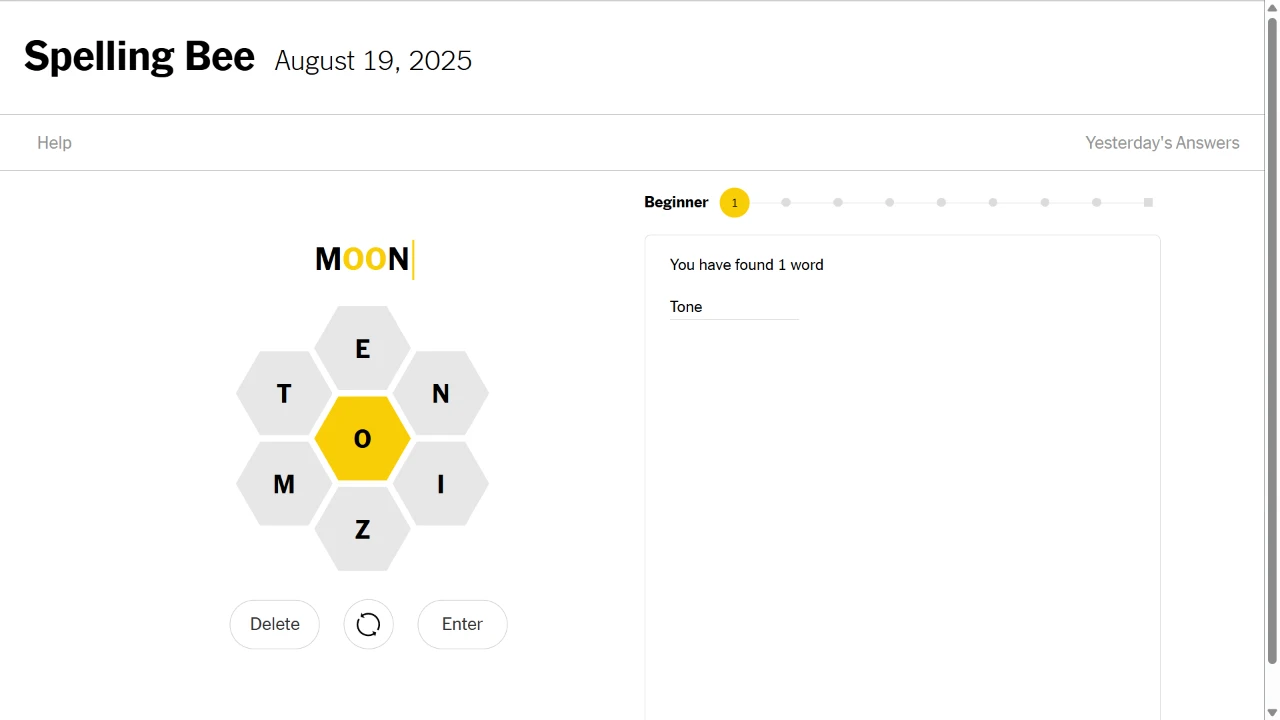
Open the player and read the date and center letter before entering a word. Click hive letters or type on a physical keyboard, use Delete or Backspace to edit, and submit with Enter. The Shuffle control rearranges outer letters without changing the puzzle; it is a perspective tool, not a new board. We begin by listing common four-letter words containing the center, then expand them with prefixes, suffixes, and repeated letters. An accepted entry increases the word list or score. A rejected one may be too short, omit the center, use an outside letter, or simply be absent from this build's dictionary.
High scores come from morphology. One productive root can generate several legal words, but only if every transformation preserves the center letter and stays within the seven-character alphabet. We test noun-to-verb changes, agent endings, tense changes, and compounds systematically rather than randomly. The pangram may contain repeated letters, so using all seven does not mean using each exactly once. Dictionary boundaries remain important: proper nouns, hyphenated forms, and specialized words may fail even when spelled correctly. We treat a rejection as information about this build, record it once, and move on. Because the page is an archive snapshot, the best advanced goal is completeness and method, not maintaining a current daily streak.
Why plausible words can be rejected
The central-letter rule causes most early rejections. A perfectly valid English word still fails if it uses only outer letters. The next trap is assuming each letter can be used once, which hides many everyday answers. We do not interpret rejection as proof that our spelling is wrong until we check length, center inclusion, allowed characters, capitalization, and dictionary scope. Since this is an archived snapshot, refreshing in search of a new daily board is also misguided. When progress stalls, we audit the existing word list by stem—nouns, verbs, adjectives, and common transformations—rather than entering random strings. That keeps the search systematic and reveals which productive families we have ignored.
- Submitting a word without the center letter, even when every outer letter is legal.
- Assuming each hive letter may be used only once and missing doubled-letter words.
- Treating one rejected word as proof that an entire root family is unavailable.
- Searching only long words and leaving easy four-letter points unclaimed.
- Expecting the archived puzzle date to follow the current daily New York Times board.
A complete hive sweep from easy words to cleanup
We search in layers. Layer one collects obvious four- and five-letter words containing the center. Layer two expands each accepted stem into plurals, verb forms, comparative forms, and common prefixes when the required letters are available. Layer three deliberately looks for repeated-letter words that the single hive tiles do not visually suggest. Layer four is the pangram hunt: write all seven letters, group likely consonant and vowel clusters, and test longer constructions using the full set. After each layer, Shuffle breaks the visual arrangement before we repeat the scan. We also review the accepted list alphabetically so missing families stand out. This route gives the puzzle a clear stopping point even when the dictionary still contains obscure entries.
Our run began with short words around the center letter, then stalled after the most obvious suffixes. Shuffling did not change the rules, but it broke the visual pairings we had unconsciously memorized. A new stem appeared, and adding a prefix brought six of the seven letters together; one longer suffix completed the pangram. The final cleanup came from returning to four-letter words, where two repeated-letter entries had been overlooked. The board rewarded a change of search method, not a random flood of guesses.
For a focused drill, set a five-minute timer and work only from stems, then spend another five minutes on suffixes and repeats. Compare which phase produced more accepted words. A second exercise hides the outer arrangement: copy the seven letters in a straight line, mark the center, and build words without relying on adjacency. This corrects the false impression that neighboring hive tiles must connect. We also keep a rejection log divided into rule failure and dictionary failure. After several sessions, the log reduces repeated bad entries and highlights which word families are genuinely weak. Since the archive does not change, improvement is visible as reaching the same rank faster and finding the pangram with fewer random attempts.
Shuffle, keyboard input, and mobile entry
Both desktop and mobile input work well because there is no time pressure. The on-screen hive prevents outside letters on touch devices, while a hardware keyboard is faster for testing word families. Portrait mode shows the hive and submitted list clearly; webpage fullscreen helps if browser controls crowd the result panel. Shuffle is especially useful on small screens where the fixed arrangement encourages visual tunnel vision. Browser storage may remember the archived run, so private mode can appear fresh while a normal tab resumes. We leave the frame focused only while typing, since browser shortcuts can otherwise intercept Backspace or letter keys.
Spelling Bee FAQ
Is this a current daily Spelling Bee?
No claim is made that it updates daily. The game visibly presents an archived August 19, 2025 puzzle.
Must every word use the center letter?
Yes. A word made only from outer letters is rejected even when it is valid English.
Can letters repeat?
Yes. The single hive tile does not limit how many times that letter may appear in one word.
What is a pangram?
It is an accepted word that uses all seven hive letters at least once, including the required center.
Why is a valid-looking word rejected?
It may be short, omit the center, include an outside letter, be a proper name, or fall outside the build's curated dictionary.