

Quardle rules: four targets in one crossing grid
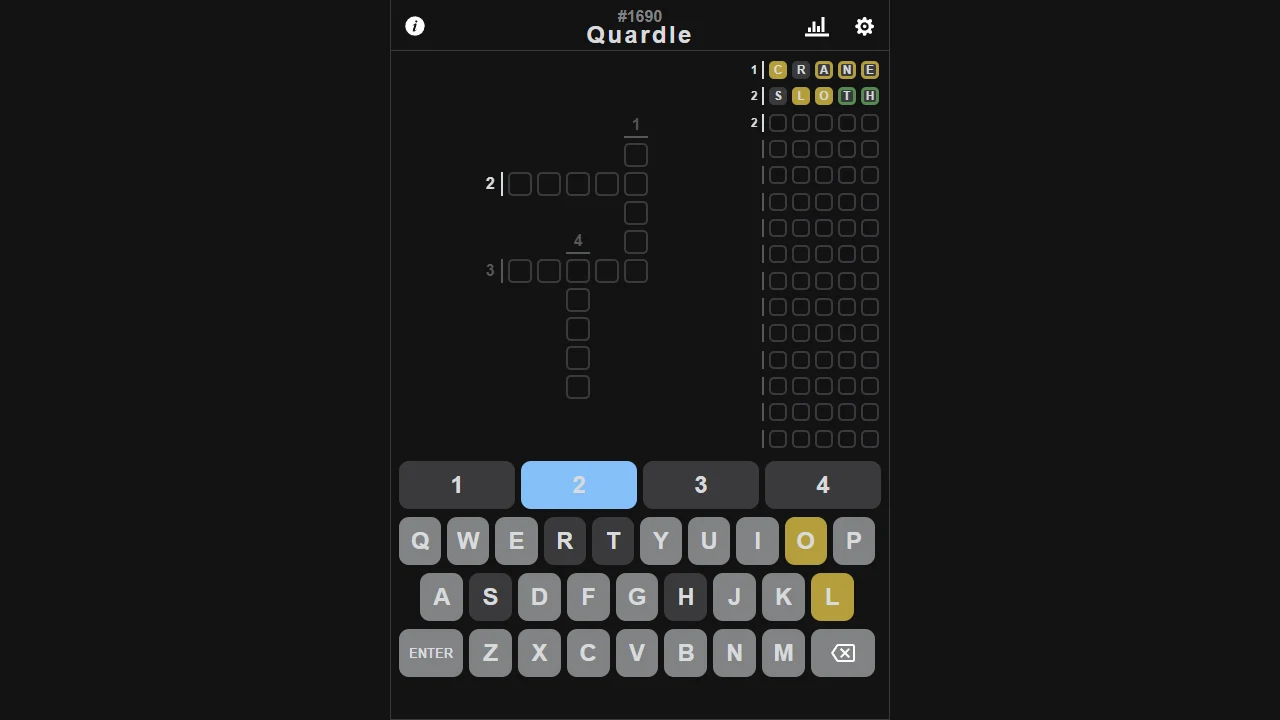
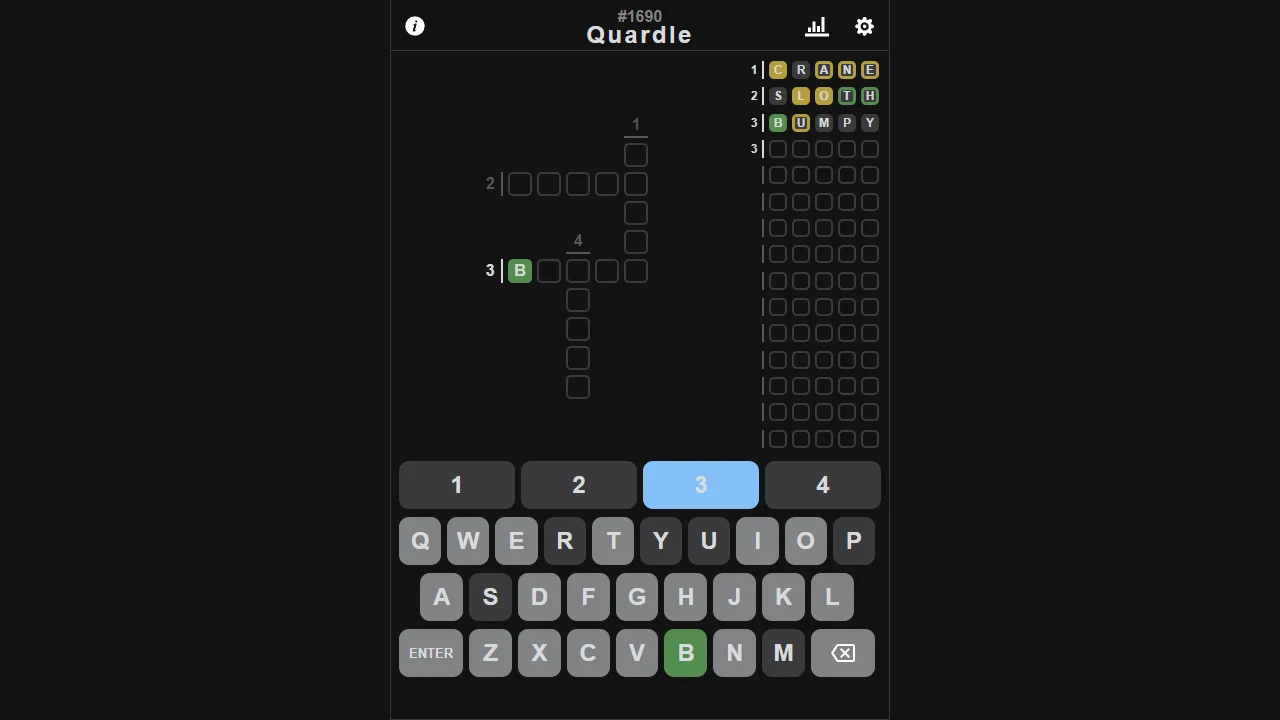
Quardle is a crossword of four hidden five-letter words, not the better-known Quordle layout with four independent grids. Two answers run across the cross-shaped board and two run vertically, with shared crossing squares linking their positions. Before every guess, we choose word 1, 2, 3, or 4, then enter a five-letter word for that selected answer. Feedback describes both the selected word and the other words in the crossword. That cross-word information is the feature that makes Quardle different: a letter rejected from word 1 may still be highlighted because it belongs to word 3, sometimes even in the same numbered position.
Target selector 1–4 and the five-color language
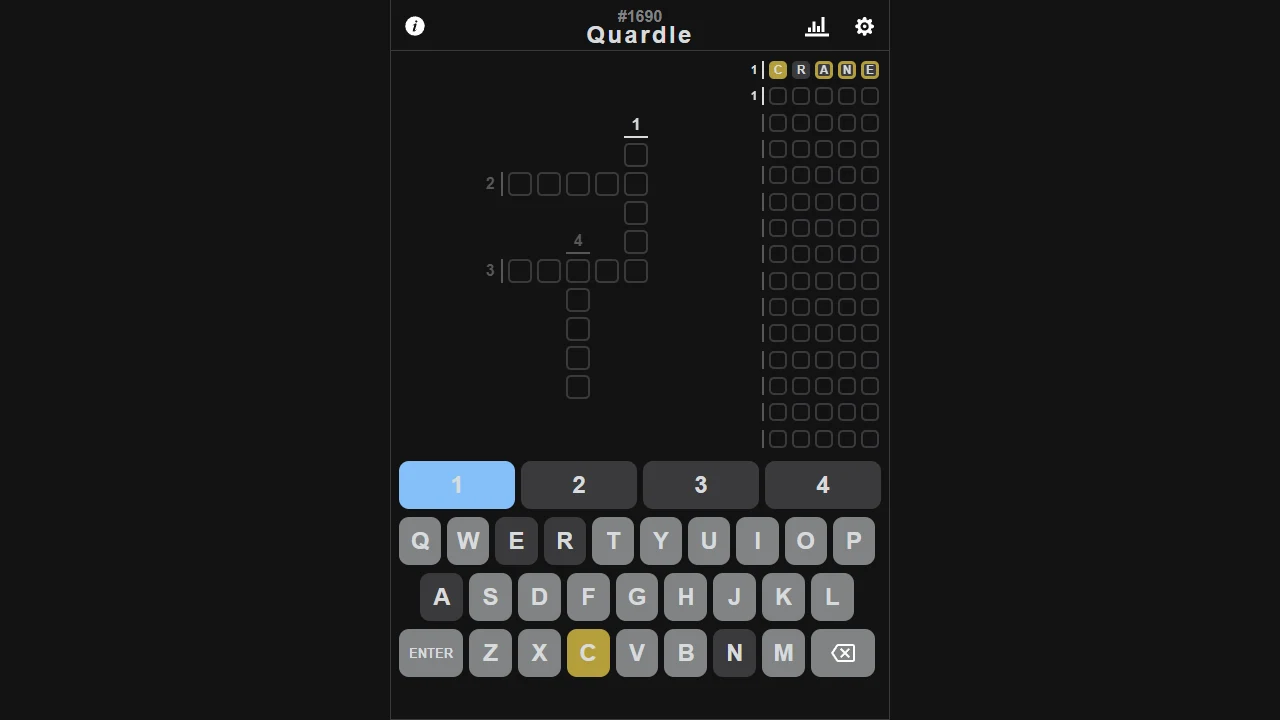
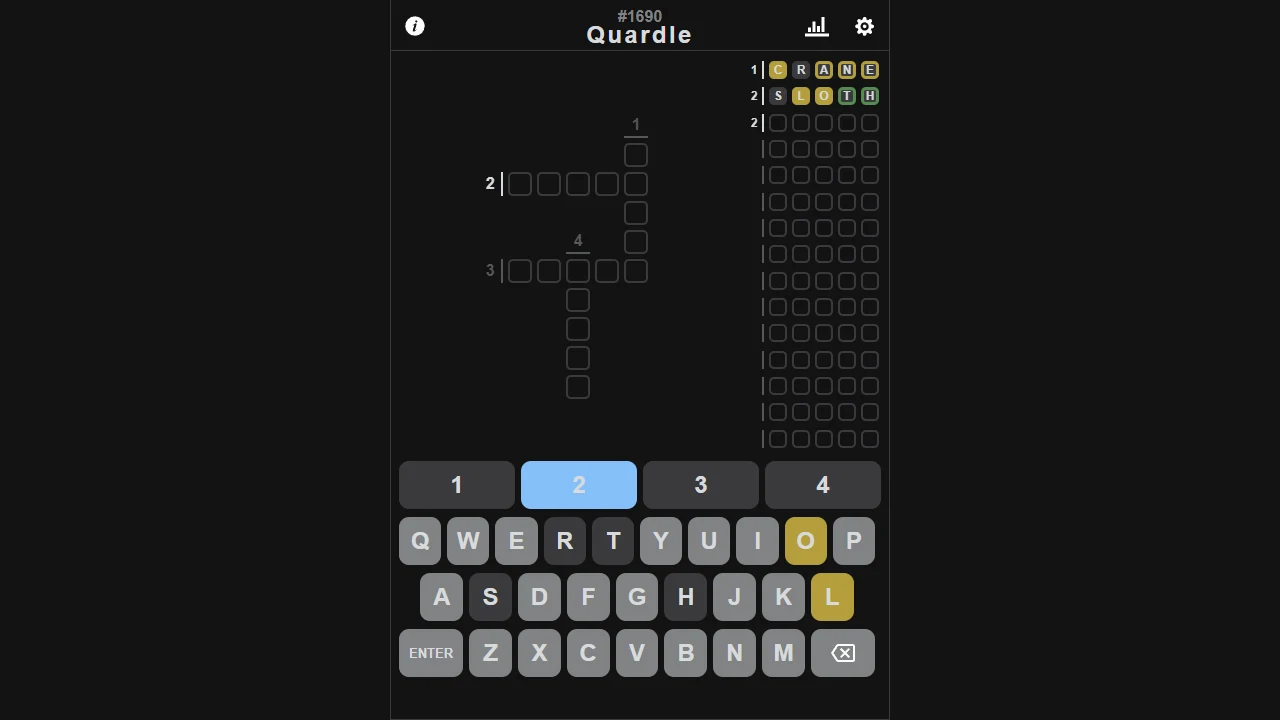
Press one of the numbered buttons below the crossword before typing. The selected number turns blue and the matching line on the grid is emphasized. Enter a valid five-letter word and press Enter; the result appears in the history column with its word number. We begin on a word whose crossing squares can feed two neighbors, usually word 2 or 3 depending on the daily shape. CRANE is a useful coverage guess, but the correct opener matters less than reading all five colors afterward. We write the selected word number next to every note because the same colored letter has a different meaning when the selector changes.
| Feedback state | What it says | Crossword consequence |
|---|---|---|
| Correct on the active word | Letter and position are fixed for that target | Any shared square becomes evidence for its crossing target |
| Present elsewhere | Letter belongs in the active answer | Do not assume the same position rule on another numbered word |
| Absent from active word | This target cannot use the unmatched letter | The letter may still be valid on a different target |
| Crossing or solved indicator | The grid has inherited confirmed information | Recount open slots before entering another probe |
| Inactive or neutral state | No judgment for the selected target | Switch selectors deliberately before interpreting colors |
The 1–4 selector is part of the puzzle, not a cosmetic tab. A guess is judged against the active target, so the same letter can be useless for one word and essential for another. Before every submission we say the target number aloud, trace its path through the crossing layout, and confirm the cursor belongs to that word. Misreading feedback from target 2 as evidence for target 3 corrupts the entire notebook.
How solved positions transfer between words
Green means the letter belongs in that exact position of the selected word. Yellow means it belongs in the selected word but in another position. Quardle then adds two cross-word clues: one color indicates that the letter is absent from the selected answer but appears in the same position of another hidden word, while another indicates that it appears elsewhere in another word. A dark or neutral tile means the letter was not found in any of the four answers under that feedback. The current rules give twelve base guesses; solving the first three words awards one extra guess each, creating a possible total of fifteen. Those bonus attempts make early confirmed solves strategically valuable.
Choose the word with the highest crossing yield
We rank targets by two values: how close they are to a solve and how many unsolved neighbors their confirmed squares will help. A nearly solved edge word with only one shared cell may be less valuable than a moderately constrained central word that feeds two crossings. Once a word is solved, we immediately revisit the others and fill every inherited position before spending a new guess. That turns one correct answer into several free letters.
Quardle strategy for choosing the next target
Our strongest approach alternates local solving with crossword transfer. After guessing word 1, we record its ordinary green and yellow clues first. Then we move every cross-word clue into a separate table labeled words 2–4, preserving whether the position is known. Crossing squares are priority targets because confirming one letter fixes a position in two answers. We do not enter the same broad probe against all four selectors; that spends the shared budget while repeating information already visible in the history. Instead, the next guess targets whichever word received the most transferred evidence. Once an answer is nearly forced, we solve it to earn the bonus guess and expose its crossing letters with certainty.
Advanced play depends on decoding positional cross-clues precisely. A letter marked as occupying the same position in another answer should be written under that column for every plausible recipient, then reduced using crossing geometry and existing exclusions. A letter known only to exist elsewhere is weaker; it belongs in a candidate pool, not a fixed slot. Because two words may share a crossword square, a confirmed crossing can identify which recipient the clue referred to. We also choose answer order strategically. Solving a word with two useful crossings can reveal more than solving an isolated-looking line, and earning a bonus earlier protects the remaining budget. This is route planning across one connected puzzle, not four separate races.
A 12-guess run from opener to fourth word
A full route starts with one high-coverage guess on a crossing-rich word. We split its result into selected-word facts and other-word facts. Next, choose the word with the largest combination of transferred letters and known crossing squares. Repeat this process until one answer has a narrow candidate list, then convert that answer rather than continuing broad probes. The first solved word locks two or more crossing positions; the second should ideally use those anchors to resolve another line. After three answers, the last word is usually constrained by crossings and inherited color clues, and the awarded bonus attempts provide the final margin. At every stage, count guesses from the twelve-base budget and add bonuses only after the game actually grants them.
- Survey all four targets
Use early entries to identify which numbered word has the strongest pattern rather than committing to target 1 by habit.
- Solve for crossings
Prefer a target whose confirmed letters will occupy several shared squares and reduce the remaining boards.
- Recalculate after each solve
Switch through targets 1–4, record inherited letters, and reorder the remaining words by constraint.
- Protect the final budget
With few guesses left, stop broad probing and submit only candidates that satisfy active-word clues plus crossing letters.
Bonus guesses, failure pressure, and recovery
For practice, play one puzzle while keeping a four-row note labeled 1–4. After each guess, place every clue only in the row it truly supports and mark cross-word evidence with a different symbol. At the end, compare the notes with the solved crossword and find any clue that was assigned to the wrong target. A second drill limits us to one broad opener; every later guess must either be a plausible answer or exploit a known crossing. This exposes wasteful repeated coverage quickly. Track whether losses come from vocabulary, color interpretation, selector mistakes, or assuming bonuses too early. Quardle becomes much more manageable once color interpretation and word numbering are reliable.
The most damaging mistake is treating Quardle like Quordle and assuming one submitted guess is evaluated as four independent Wordle rows. It is not: we select one target, and the extra colors summarize relationships to the remaining crossword answers. Another error is forgetting which number produced a history row, then applying a yellow to the wrong pattern. We also avoid spending four opening guesses by entering the same word once for each selector. Cross-word colors already carry evidence between answers. Finally, the apparent fifteen-guess maximum is conditional; we begin with twelve and only reach fifteen by solving the first three words, so late rescue attempts cannot be assumed in advance.
In our complete run, the first target looked easiest but offered little help elsewhere. Target 3 had one extra uncertainty yet intersected two unsolved words, so we finished it first. Those crossings collapsed target 1 to two candidates and revealed that our original favorite violated a shared position. The second solve fed target 4, and the fourth word became a direct answer rather than another probe. The order—3, 1, 4, 2—was not a trick sequence; it was simply the changing value of the crossings.
Desktop selector keys and touch accuracy
The crossword and history fit best on desktop because the active word, result list, selector, and keyboard remain visible together. On a phone, use portrait mode and check the blue numbered selector before every entry. The compact grid uses direction and number rather than four large panels, so zooming too far can hide which line is active. Physical and on-screen keyboards both work, and there is no timer requiring rapid input. Let the colors settle before changing selectors. If typing does nothing, tap the chosen number again and then the game area; repeated Enter presses can submit an unintended partial state when focus returns.
- Entering a valid word under the wrong selector and then recording its colors against the wrong target.
- Reading an absent letter as globally absent even though feedback belongs to one numbered answer.
- Solving the easiest isolated word first while ignoring a central target with better crossing yield.
- Failing to revisit every unsolved word after a crossing square becomes fixed.
- Using bonus guesses as permission for random probes instead of as insurance for the final target.
Quardle FAQ
Is Quardle the same as Quordle?
No. Quardle uses four connected crossword words and asks us to select one numbered word before each guess.
How many guesses are available?
The rules provide twelve base guesses. Solving the first three words grants one bonus each, allowing up to fifteen.
Does a guess apply equally to all four words?
No. It targets the selected numbered word, while extra feedback colors reveal relationships to the other answers.
Why are there more than three clue colors?
The additional colors distinguish letters that belong in another word, including whether the position matches.
Which word should we solve first?
Prefer the word with strong clues and useful crossing squares, since its confirmed letters can constrain neighboring answers.