
Letter Boxed rules for four sides and 12 letters
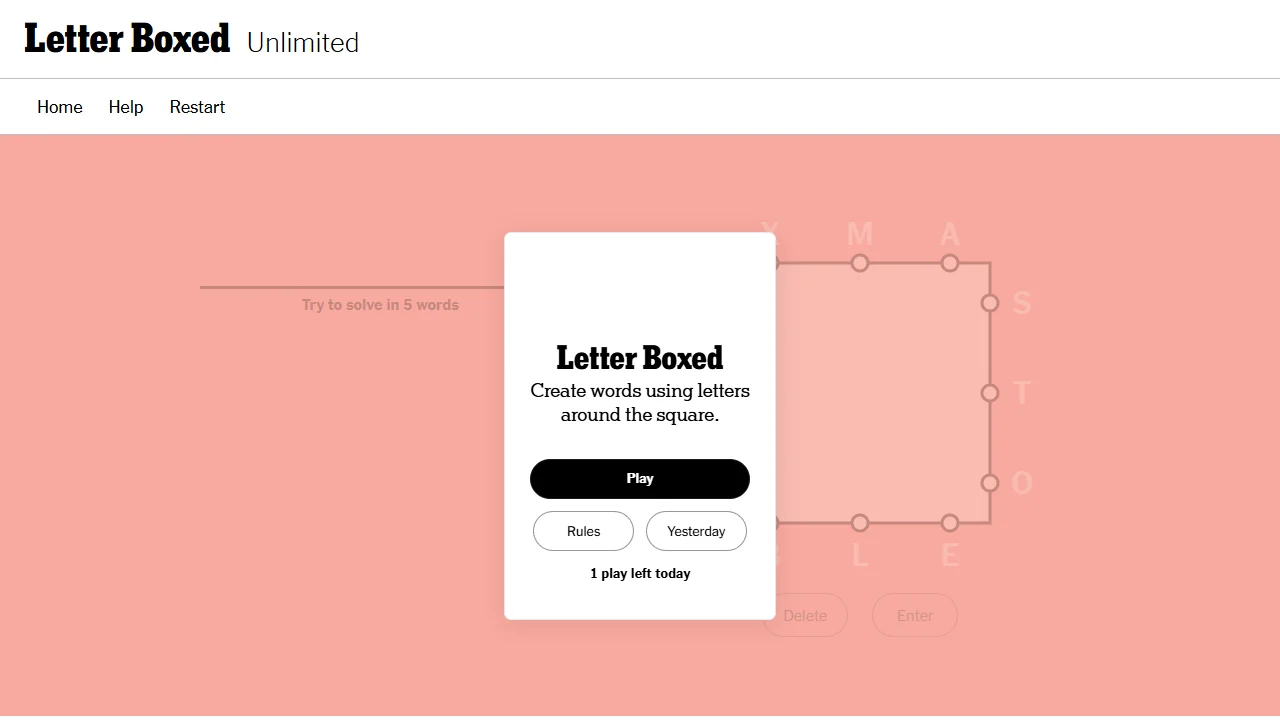
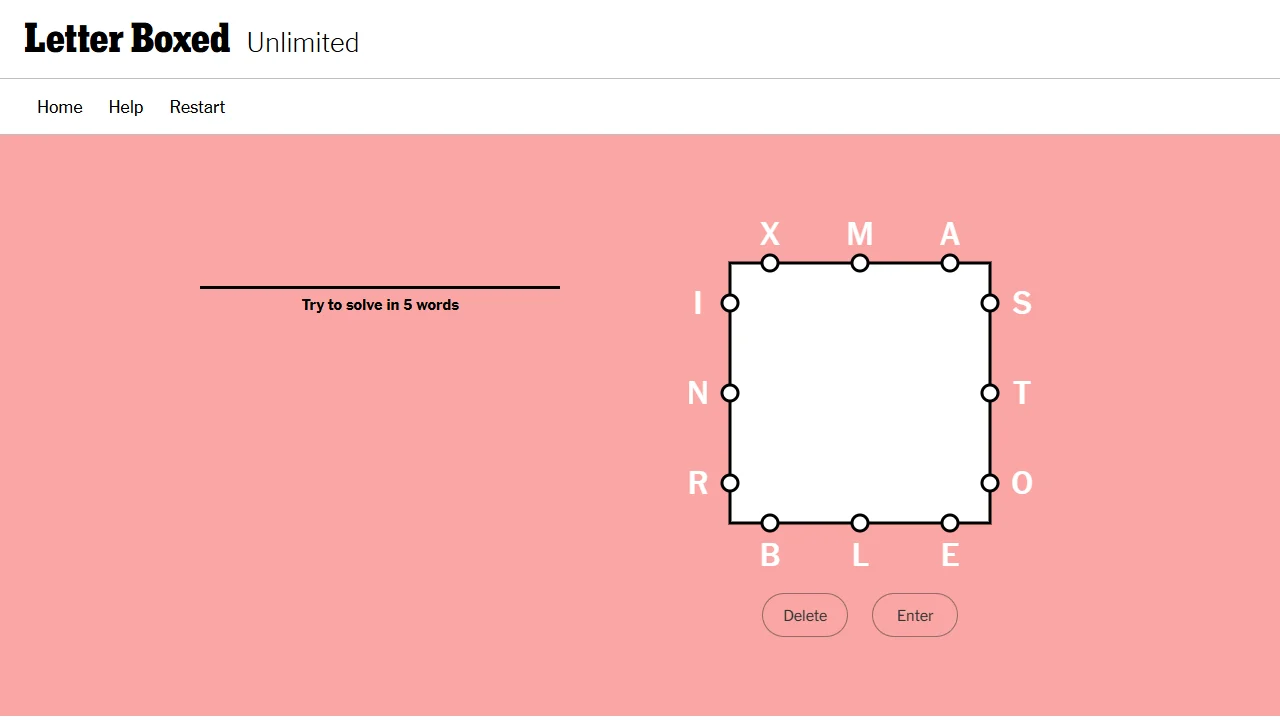
Letter Boxed places twelve letters around four sides of a square. We build words by selecting letters, but consecutive letters cannot come from the same side. After a valid word is accepted, its final letter becomes the mandatory first letter of the next word. The puzzle is complete only after every border letter has appeared somewhere in the chain. The unlimited URL used here is useful for practice because we can concentrate on structure rather than wait for another board. The small number of letters is deceptive: the hard part is not finding one word, but leaving a productive ending for everything that follows.
| Board fact | Legal consequence | Planning consequence |
|---|---|---|
| Four sides, three letters each | Consecutive letters must change sides | Record side positions, not only the 12-letter inventory |
| A letter may be reused | Repeated characters are legal when the side alternation remains legal | A useful bridge can appear more than once in a word |
| Last letter starts the next word | The chain has a forced handoff | Judge a word by its ending as well as its coverage |
| Every letter must appear | Short easy words can still leave an impossible residue | Track uncovered letters after each accepted word |
Build legal words without repeating a side
Open the player and study the four groups before selecting anything. On desktop we can click letters; on touch screens we tap them. The center line shows the current spelling, Delete removes the latest choice, and Enter submits a valid word. Entries need at least three letters and must respect the alternating-side rule from the first pair onward. In our tests, starting immediately was worse than spending half a minute identifying uncommon letters, likely suffixes, and letters that can serve as bridges. A word that covers six easy letters but ends on an awkward consonant can make the remaining board much harder.
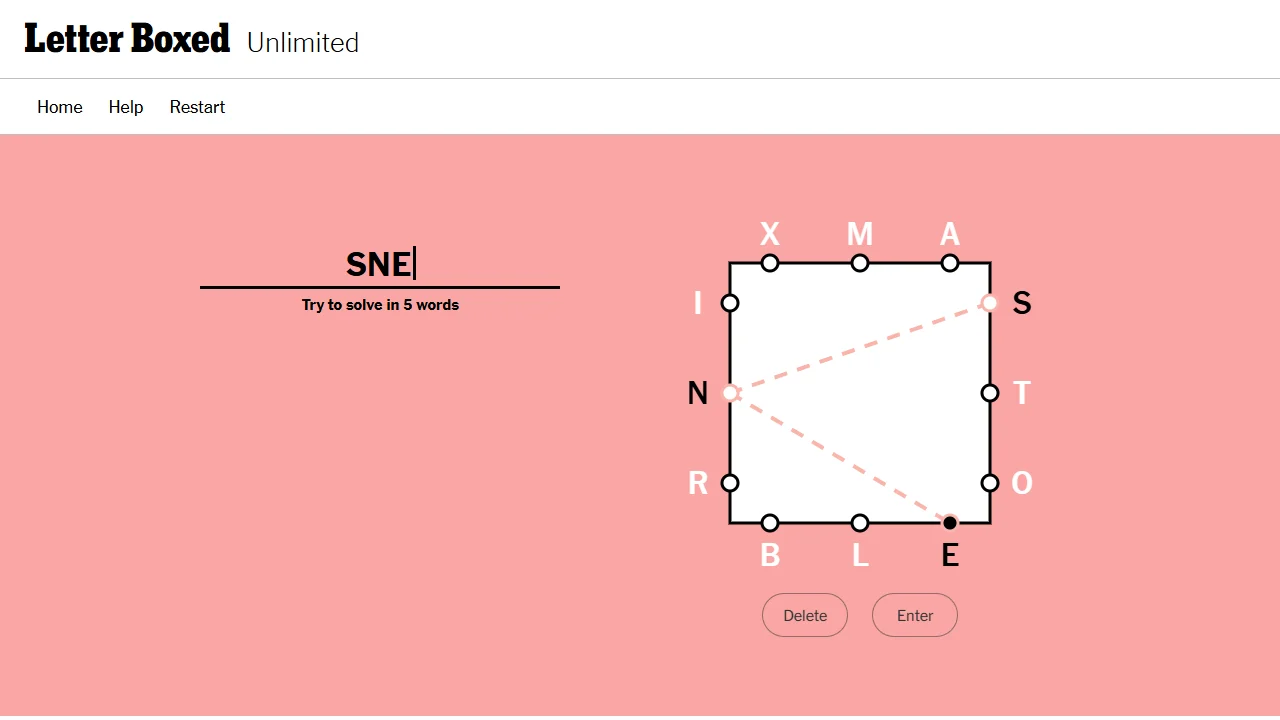
A letter may be reused, and a side may reappear after one letter from another side; only two adjacent selections from the same side are forbidden. The link between words is equally strict: if the accepted word ends in R, the next entry begins with R. Coverage is global, so letters used in an earlier word stay credited even when they appear again later. This means a long word is not automatically superior. We judge a candidate by three values: how many unused letters it covers, whether its internal side pattern is legal, and whether its final letter opens a strong next word. The drawn path is a quick visual check for accidental same-side moves.
Bridge letters and word-to-word handoffs
We draw a quick coverage map before chasing a two-word finish. The rarest-looking consonant, awkward corner pair, or limited vowel usually deserves a route first. A long word that clears eight ordinary letters but strands Q, J, or a difficult same-side pair can be worse than a six-letter word with a strong final letter. The chain lives or dies at the join, so we circle the last letter of every candidate and ask what plausible word can start there.
The bridge-letter test
The deeper puzzle is a graph problem. Each side is a group, every legal adjacent pair crosses between groups, and the end of one word creates the entrance to the next. We exploit that by looking for hub letters that can connect to many letters on the other three sides. A rare letter should usually sit inside a word, not at its end, unless we already know a continuation. Compounds and inflected forms can provide broad coverage, but the in-game dictionary decides what is acceptable. When aiming for two words, we work in both directions: propose a high-coverage first word, then search specifically for a second word starting with its final letter and containing every uncovered character. If that second word cannot exist, we change the endpoint rather than endlessly modifying the middle of the first word.
Letter Boxed strategy for a two-word solution
We work backward from the hardest letter. If the board contains J, Q, X, or a lonely vowel, we list legal neighbors from the other three sides and look for words that place the difficult letter away from an impossible ending. Then we search for a partner whose first letter matches that ending and whose body absorbs most remaining letters. A two-word solution is satisfying, but forcing it can waste time; a clean three- or four-word chain still solves the board. When stuck, we keep the valid prefix and vary the next side instead of erasing the entire word. We also use repeated bridge letters deliberately, because one flexible vowel can connect several otherwise incompatible sides.
A good bridge performs three jobs at once: it legally ends the current word, begins a second word with several uncovered letters, and does not force that second word into an immediate same-side violation. When two first words cover the same number of letters, we prefer the one ending in a flexible consonant or vowel. Endings such as S, R, T, A, and E tend to offer more continuations than a rare terminal letter, although the actual board always overrides frequency.
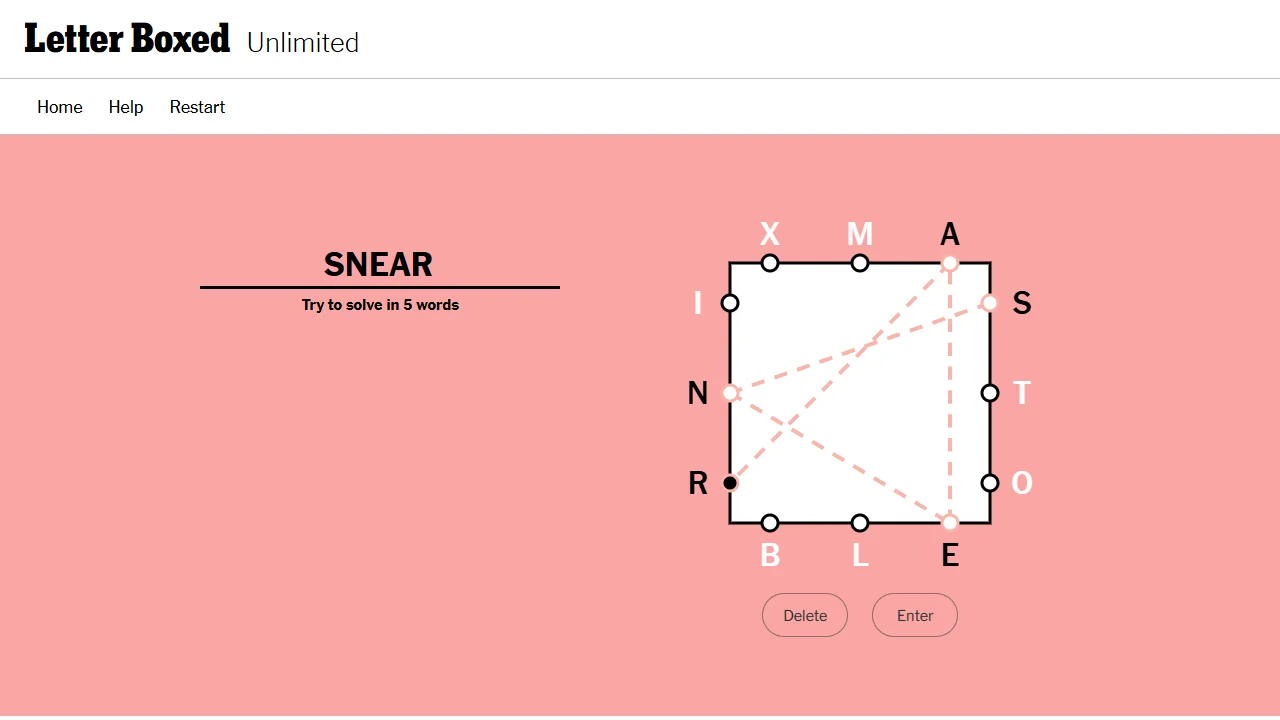
Our full-board route begins before the first word. We copy the four sides as four short groups and circle letters with few natural neighbors. Next we build two candidate banks: words that cover difficult letters and words with flexible final letters such as S, R, N, or E. We do not submit yet. We connect the banks by matching the end of one word to the beginning of another, then count how many unique border letters the chain covers. If two chains cover the same number, we prefer the one whose final letter has more continuations. After submission, we cross off used letters but keep bridge letters available for reuse. With three or fewer letters remaining, we search for a single word containing them all before adding filler. This route prevents the familiar situation where eleven letters are covered and the twelfth cannot legally connect.
Dead chains, unused corners, and recovery
The first repeated error is confusing a geometric diagonal with legality. The rule concerns labeled sides, not how far the path travels: two letters on the top edge are illegal even if they are far apart. The second is submitting a brilliant word that ends with a letter offering no usable continuation. Short filler words can rescue a chain, but each one adds another mandatory endpoint. We also watch for a final unused letter stranded on the same side as all realistic neighbors. Before Enter, we trace the word one pair at a time, note its last letter, and name at least one possible next word. That habit prevents most dead chains.
In our strongest run, the first tempting word used many tiles but ended on a letter with almost no legal continuation. We backed out before submission, found a shorter word that ended on a flexible bridge, then built the second word around the four remaining tiles. The pair looked less impressive one word at a time, yet it solved the board cleanly. That is the central Letter Boxed lesson: coverage, alternation, and the handoff are one problem, not three separate checks.
- Mark the stubborn letters
Identify the letters with few obvious alternating neighbors and include them in the first planning pass.
- Draft the second word backward
Choose a promising handoff and sketch a word that covers the leftover set before committing the first word.
- Trace every side transition
Read the candidate pair letter by letter. One same-side jump invalidates an otherwise perfect-looking chain.
- Submit only after the coverage count
Confirm all 12 letters appear somewhere across the chain; repeated letters do not replace a missing tile.
A useful practice exercise ignores the two-word target. First solve the board in any legal number of words, then inspect the accepted chain and mark which words contributed only one new letter. Replace those weak links with longer words that share the same required starting letter. On the next attempt, set a four-word ceiling, then three. This teaches compression without making the opening search feel impossible. We also practice side validation by tracing candidate words with a finger before entering them; any same-side pair is rejected immediately. After several boards, keep a personal list of productive bridge endings and difficult-letter words. The point is not to memorize one puzzle, but to build a vocabulary organized around the game's actual constraints.
Touch tracing, keyboard entry, and board reading
Letter Boxed is comfortable on both desktop and mobile because the input is deliberate rather than timed. A larger player helps when letters sit close to one another, and webpage fullscreen reduces accidental taps outside the square. The unlimited mode may preserve progress locally, so a refresh can change or clear the current chain depending on the build. If a tap selects the wrong letter, use the in-game delete control rather than the browser Back button. Physical keyboard input is not required. We found touch especially natural for following the path, while desktop made it easier to keep a separate candidate list beside the board.
Letter Boxed FAQ
Can consecutive letters come from the same side?
No. Every neighboring pair in a word must alternate between different sides of the square.
Does the next word have to link?
Yes. It begins with the final letter of the previously accepted word.
May we reuse letters?
Yes. Reuse is allowed and often necessary; the goal is simply to include all twelve at least once.
Is two words required?
No. Two is an elegant target, but a longer legal chain that covers every letter also completes the puzzle.
Why will a real word not submit?
It may violate the side rule, be shorter than three letters, fail the dictionary, or begin with the wrong link letter.