
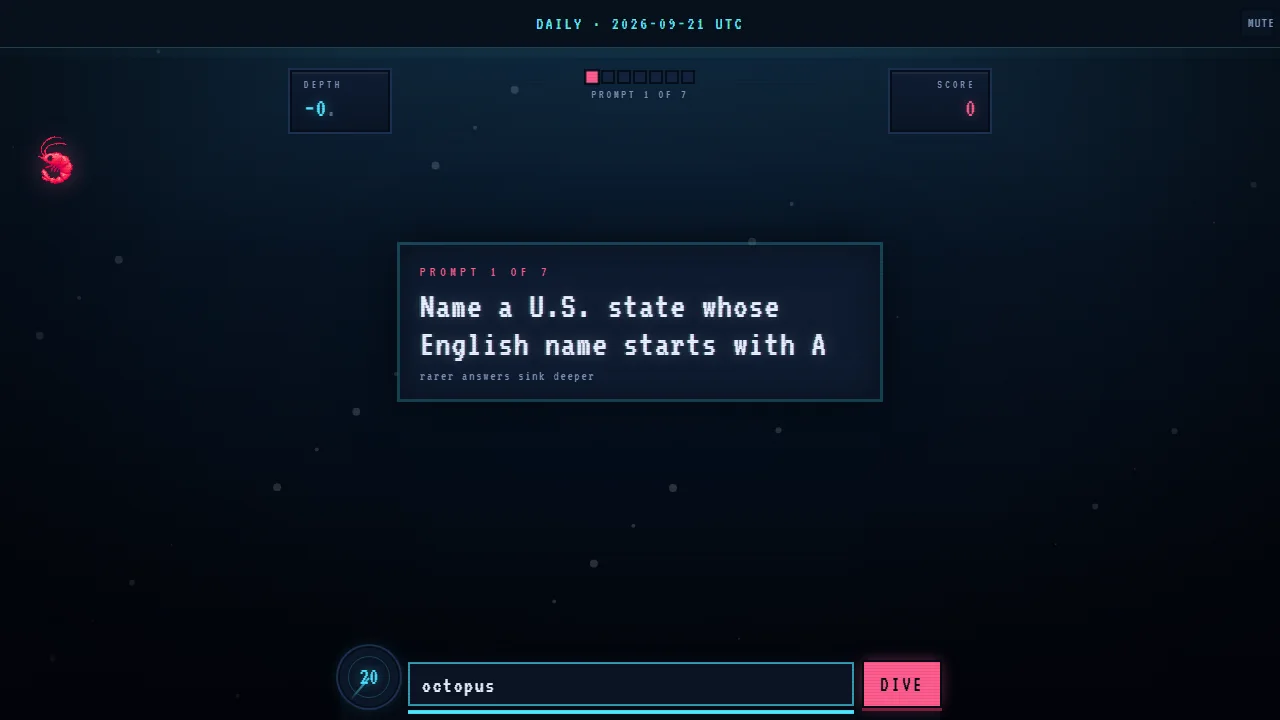
Krillion scoring tiers and exact point values
Every accepted Krillion answer lands in one of six visible rarity tiers. The tier awards a fixed number of points; it is not a smooth percentage scale. Moving from Schooler to Rare doubles the value from 30 to 60, while moving from Deep Cut to One in a Krillion adds only 15. That uneven ladder explains why a secure Rare answer is often a better decision than gambling an entire prompt for the top label.
| Rarity tier | Points | Depth added | Practical reading |
|---|---|---|---|
| Plankton | 10 | 100 m | Valid and among the crowd's most automatic answers |
| Too Clever | 15 | 150 m | A small move beyond the default |
| Schooler | 30 | 300 m | A solid middle answer |
| Rare | 60 | 600 m | Clearly uncommon while still recognisable |
| Deep Cut | 85 | 850 m | Specialist recall with clean category fit |
| One in a Krillion | 100 | 1,000 m | Maximum value for one prompt |
Read the jumps, not only the labels
Plankton to Too Clever gains five points. Too Clever to Schooler gains fifteen. Schooler to Rare gains thirty—the largest single jump. Rare to Deep Cut adds twenty-five, and Deep Cut to the maximum adds fifteen. Aiming for the Rare band is therefore a sensible centre of gravity: it captures the biggest step without demanding that every answer be uniquely obscure.
Convert Krillion score into dive depth
The depth formula is exact: depth in metres equals total score multiplied by ten. There is no hidden bonus for a streak, no multiplier for answering quickly, and no extra conversion step. A 295-point result is 2,950 metres. A 445-point result is 4,450 metres. Seven maximum answers total 700 points, so the theoretical ceiling for a standard seven-prompt Daily Dive is 7,000 metres.
| Seven-answer profile | Calculation | Score | Depth |
|---|---|---|---|
| All Plankton | 7 × 10 | 70 | 700 m |
| All Schooler | 7 × 30 | 210 | 2,100 m |
| All Rare | 7 × 60 | 420 | 4,200 m |
| All Deep Cut | 7 × 85 | 595 | 5,950 m |
| All One in a Krillion | 7 × 100 | 700 | 7,000 m |
| Mixed example | 10 + 15 + 30 + 60 + 85 + 100 + 30 | 330 | 3,300 m |
Use a ten-second result check
Drop one zero from the displayed metres to recover the score, or add one zero to the score to predict depth. This catches transcription mistakes when comparing runs. If the result card shows 3,300 metres, the seven tiers must sum to 330 points. The formula lets us audit examples without guessing from the visual position of the dive marker.
What Krillion answer rarity does and does not measure
Rarity describes how the accepted answer sits within the game's response data for that prompt. It does not measure how difficult the fact is in every culture, how many search results it has, or whether the player is clever. A regional food may be common to one group and a Deep Cut to another. A famous supporting character may beat a franchise lead because fewer players reach for it first.
Prompt wording matters just as much as the noun. Ghana can be a perfectly valid country containing G and A, yet it may be a crowded response because the name is short and easy to retrieve. Guinea-Bissau and Papua New Guinea travel farther from the first instinct, but introduce more typing risk. The tier records the outcome of that tradeoff in one run; it does not promise the same value whenever the word reappears.
| Rarity tells us | Rarity does not tell us |
|---|---|
| How the accepted response was grouped for that prompt | That the answer is universally obscure |
| Whether our retrieval path overlapped heavily with the crowd | That a common answer was a factual mistake |
| How many fixed points the answer adds | Why an unlisted answer was rejected |
| Which categories may reward a one-ring alternative | That revealed alternatives will keep the same tier tomorrow |
Krillion rare-answer strategy: a four-level risk ladder
Choose a risk level after reading the prompt, not before the Daily Dive. A category we know deeply can support a specialist answer. A category we barely know should stay near the safe end. The four levels below make that choice explicit and stop one disappointing tier from pushing the next prompt into a reckless guess.
| Level | Candidate type | Use when | Main danger |
|---|---|---|---|
| 1 — Anchor | First obvious valid answer | Knowledge is thin or the clock is below five seconds | Crowded Plankton result |
| 2 — One ring out | Familiar secondary example | Category fit and spelling are certain | Still more common than expected |
| 3 — Specialist | Supporting character, former team, regional item, technical term | We can explain its fit immediately | Proper-name spelling or a hidden qualifier |
| 4 — Edge case | Unusual interpretation or barely recalled item | Almost never; only with clear evidence | Rejection, category drift, or timeout |
Spend confidence where knowledge is real
Our preferred profile is Level 2 for most prompts, Level 3 in genuine strengths, and Level 1 when recall is weak. Level 4 is not a normal scoring strategy. If the answer needs a paragraph of defence, the 25-second game is the wrong place to litigate it. The maximum upside over Deep Cut is only fifteen points, while rejection can cost the entire prompt.
Use five seconds remaining as an automatic downgrade. A Level 3 candidate that is not already typed becomes Level 2 or Level 1. This rule converts time pressure into a decision instead of a panic. A ten-point anchor adds 100 metres; an answer left in the field adds nothing.
Real Krillion answers and video decision points
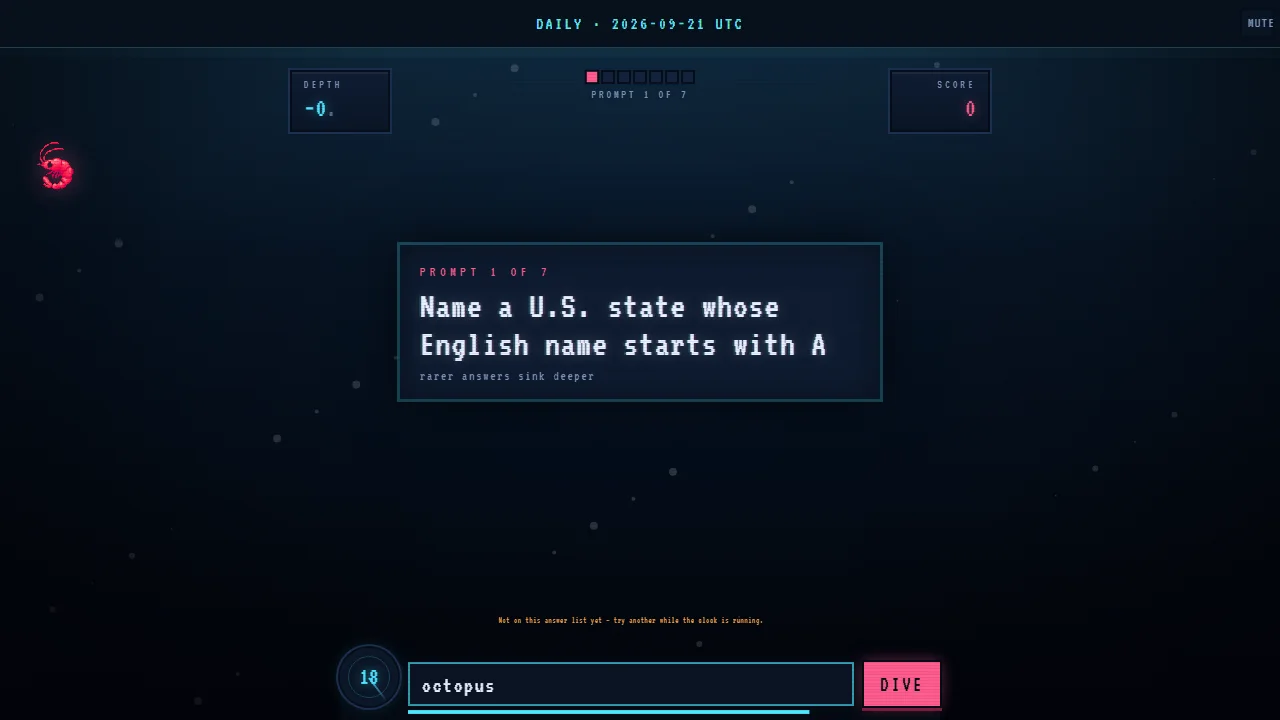
The best scoring examples include both wins and failures. In one recorded run, dango answers “food served on a stick” and earns 85 points, or 850 metres. It is a regional food with an ordinary canonical name and an exact category match: a model Level 3 answer. Rosie from The Jetsons works for a fictional robot because the player searches supporting characters rather than mascots.
| Prompt | Candidate | Outcome or issue | Scoring lesson |
|---|---|---|---|
| Food served on a stick | Dango | Deep Cut, 85 points / 850 m | Specific regional recall can be rare without being fragile |
| Fictional robot | Rosie from The Jetsons | Strong supporting-character choice | Search one level below the lead mascot |
| Ancient Greek philosopher | Seneca | Rejected category fit; Seneca was Roman | Fame and philosophy are not enough when nationality is explicit |
| Sport played over a net | Volleyball | Most common end of the pool | Automatic answers preserve points but rarely create depth |
| Country with an official state religion | Qatar | Valid guess in the recorded run | A clean country name beats an invented edge case |
| Grain or cereal crop | Buckwheat | Rare, 60 points / 600 m in another run | Everyday specialist knowledge can hit the high-value jump |
The Greek-versus-Roman mistake is the most useful negative example. The player knows Seneca and correctly identifies him as a philosopher, but the qualifier ancient Greek makes the answer invalid. Diogenes would fit the requested tradition. This is why the risk ladder begins only after category parsing: a Level 3 name in the wrong civilisation is not a daring answer; it is a zero-value mismatch.
Dango demonstrates the opposite. The answer is neither misspelled nor dressed in explanation. It simply occupies a quieter part of a broad legal category. That is the pattern worth repeating: uncommon retrieval, conventional wording, immediate category proof.
Calculate seven-answer Krillion score profiles
A final score is a portfolio of seven decisions. One spectacular answer cannot compensate for several blanks as efficiently as a steady set of middle-tier results. Compare three profiles. The safe profile—seven Schooler answers—makes 210 points. A volatile profile with one maximum, one Deep Cut, and five Plankton answers makes 235. The enormous difference in drama produces only 25 extra points. A balanced profile with four Rare, two Schooler, and one Plankton makes 310.
| Profile | Tier mix | Arithmetic | Total / depth |
|---|---|---|---|
| Safe middle | 7 Schooler | 7 × 30 | 210 / 2,100 m |
| One hero, five crowded | 1 One in a Krillion + 1 Deep Cut + 5 Plankton | 100 + 85 + (5 × 10) | 235 / 2,350 m |
| Balanced | 4 Rare + 2 Schooler + 1 Plankton | (4 × 60) + (2 × 30) + 10 | 310 / 3,100 m |
| Strong complete | 2 Deep Cut + 3 Rare + 2 Schooler | (2 × 85) + (3 × 60) + (2 × 30) | 410 / 4,100 m |
| Maximum | 7 One in a Krillion | 7 × 100 | 700 / 7,000 m |
Why completion raises the floor
Suppose a risky candidate has an uncertain chance of acceptance while a Schooler-quality answer is already available. The safe answer locks 30 points. The risky answer must be both accepted and placed high enough to justify losing that floor. Krillion does not publish enough probability data for a precise expected-value calculation, so practical confidence replaces fake mathematics: choose the higher tier only when category fit and spelling are already solid.
The balanced profile is our realistic target because it comes from repeatable choices. Four clean one-ring upgrades matter more than one miraculous maximum surrounded by rushed defaults. This also produces a calmer run; no prompt feels responsible for rescuing the entire score.
Review a complete Krillion score without chasing losses
Review the result in category order, not emotional order. First mark rejections and timeouts, because converting a zero into any accepted tier has the largest dependable effect. Next mark Plankton answers in categories we actually knew; those are candidates for a one-ring upgrade. Finally, keep the Rare, Deep Cut, and maximum answers whose category fit was clean, but record the retrieval route rather than worshipping the word.
| Review mark | Example | Next-run adjustment |
|---|---|---|
| Category failure | Seneca for ancient Greek philosopher | Read the civilisation qualifier before recalling names |
| Crowded but necessary | Volleyball for sport over a net | Accept the anchor when deeper recall is absent |
| Crowded with room | Six Flags for theme-park chain | Try a familiar secondary chain such as Legoland sooner |
| Clean rare route | Dango for food on a stick | Reuse the regional-food retrieval path |
| Timing failure | Safe answer still unsubmitted | Move the commitment line to five seconds |
Do not chase yesterday's lost points on today's first prompt. Rarity changes with the question and response pool, and knowledge strengths move from category to category. Carry one mechanical improvement—read qualifiers first, build three candidates, submit by five seconds, or check autocorrect. That creates more depth over a week than trying to force a Deep Cut after a disappointing result.
Krillion Scoring FAQ
What are the exact Krillion point values?
Plankton is 10, Too Clever 15, Schooler 30, Rare 60, Deep Cut 85, and One in a Krillion 100 points.
How is Krillion depth calculated?
Add the seven prompt scores and multiply the total by ten. A 330-point run reaches 3,300 metres.
What is the maximum Krillion Daily Dive score?
Seven 100-point answers make 700 points, which converts to the theoretical 7,000-metre maximum.
Does answering faster earn more points?
The visible scoring system awards the fixed tier value. Speed matters because it prevents timeouts and leaves recovery time, not because a fast accepted answer receives a separate bonus.
Will the same answer always have the same rarity tier?
Do not assume that. The prompt wording and response environment matter. Treat recorded tiers as examples of a retrieval route, not permanent prices attached to words.
Is a rejected rare answer better than a common valid one?
No. A rejected answer receives no rarity tier. A Plankton response still contributes ten points and 100 metres.
Which tier should we aim for most often?
Rare is a strong practical target because the jump from Schooler to Rare is 30 points. Use Deep Cut candidates when category fit and spelling are already certain.