
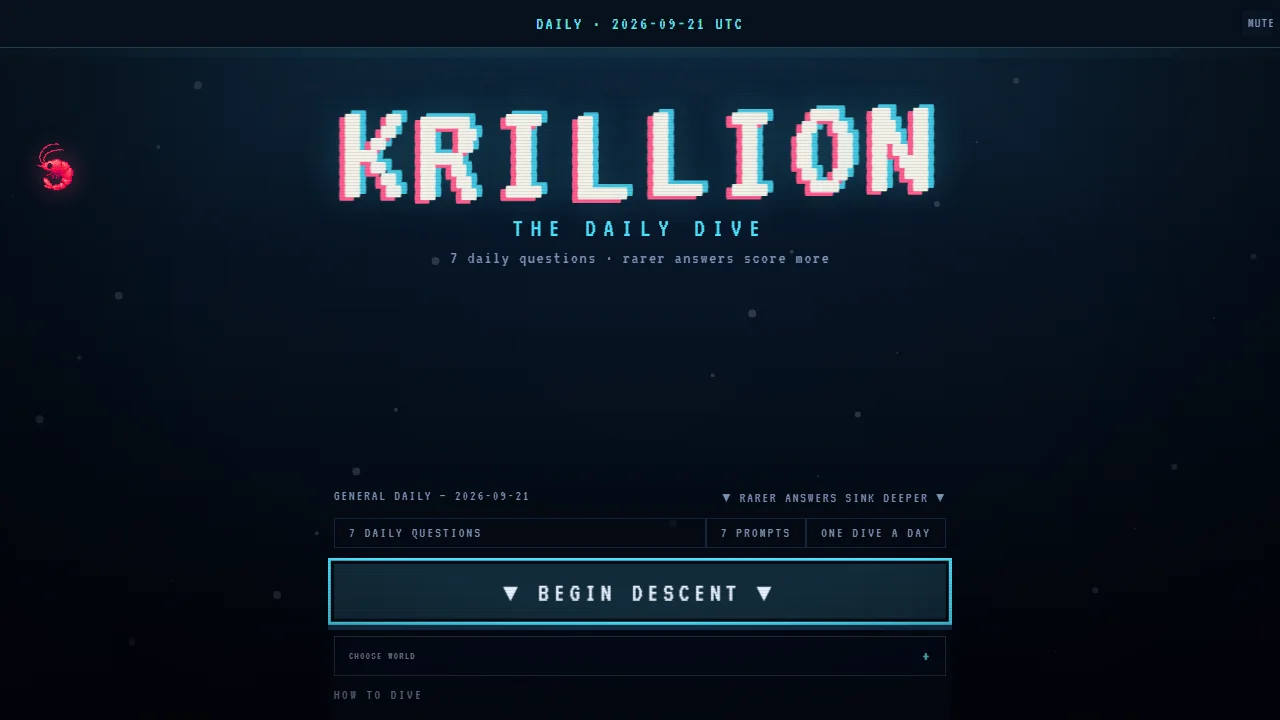
How to Play Krillion: the seven-prompt Daily Dive
Krillion is an open-answer daily trivia game: every player receives the same seven prompts, but there are no multiple-choice buttons to lean on. Each prompt gives us 25 seconds to type one response. A recognised answer earns a rarity tier and a fixed number of points; an answer that is common, outside the category, misspelled beyond recognition, or left too late can leave us near the surface. The run ends after prompt seven, when the score is converted into metres of dive depth.
The rule that matters most: valid first, rare second
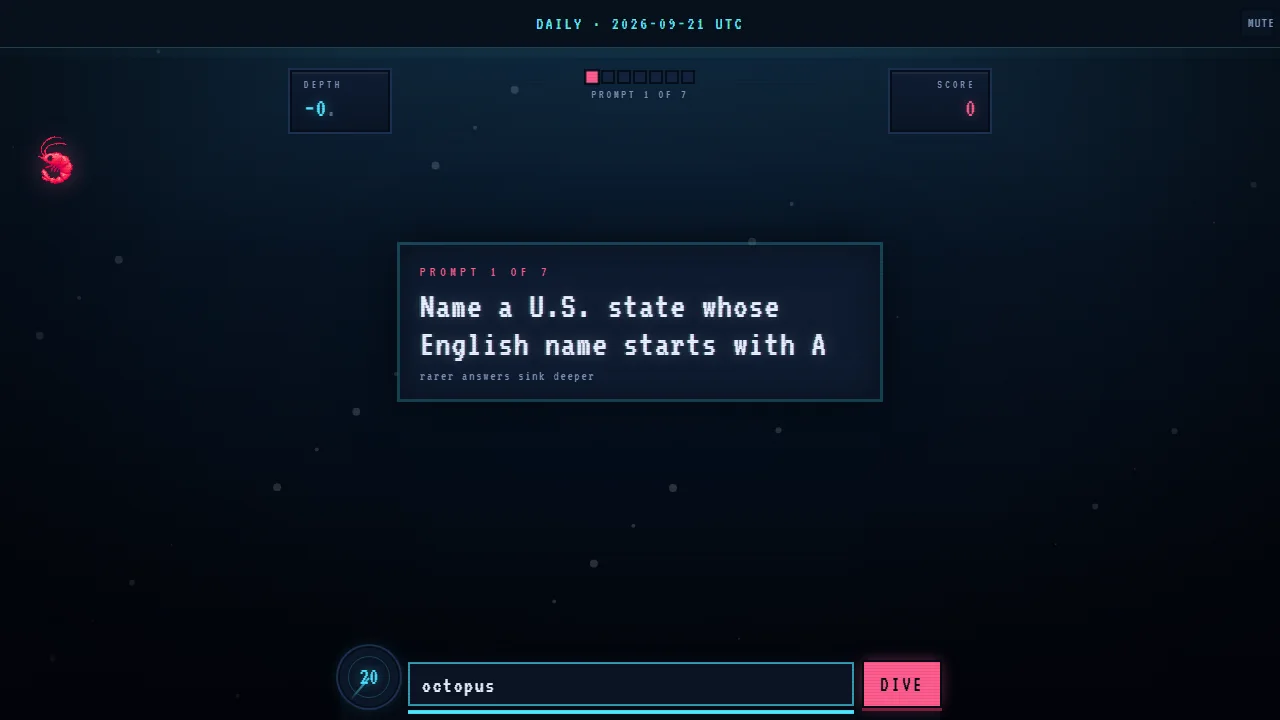
The game rewards uncommon answers, but rarity is never permission to bend the wording. If the prompt asks for a U.S. state beginning with A, our legal pool is Alabama, Alaska, and Arizona. Octopus is unusual, perfectly spelled, and still worth nothing because it is not a state. That sounds obvious when the timer is stopped; under a 25-second countdown, category drift is the most expensive beginner mistake.
We play the seven prompts as seven separate decisions. A poor first answer does not make the second prompt harder, and a Deep Cut does not buy extra time on the next screen. Resetting after every result is part of the rules in practice. The only information carried forward is the growing score and depth; the next category starts clean.
| Part of a Daily Dive | What appears | What we do |
|---|---|---|
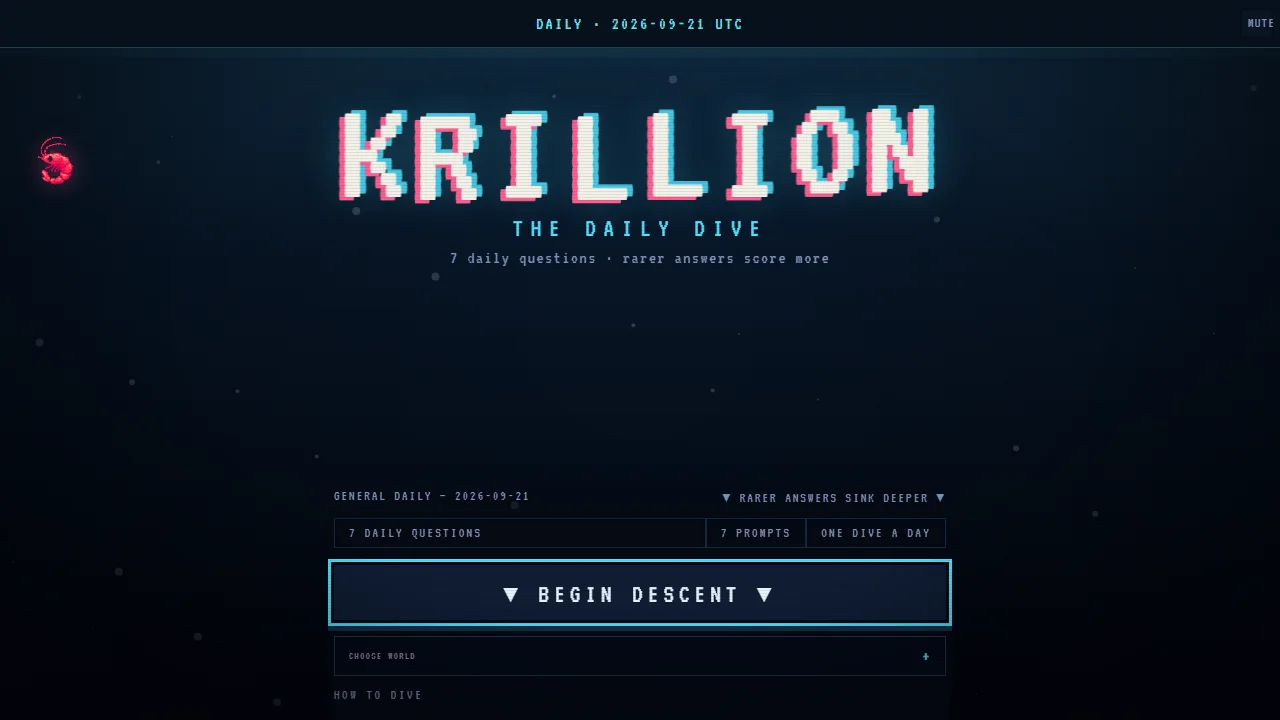
| Opening screen | Begin Descent and the seven-prompt description | Set the view and keyboard before starting |
| Live prompt | Category text, 25-second clock, answer field, Dive button | Read qualifiers, shortlist, type, and submit |
| Accepted answer | Rarity tier and points | Take one note, then reset for the next prompt |
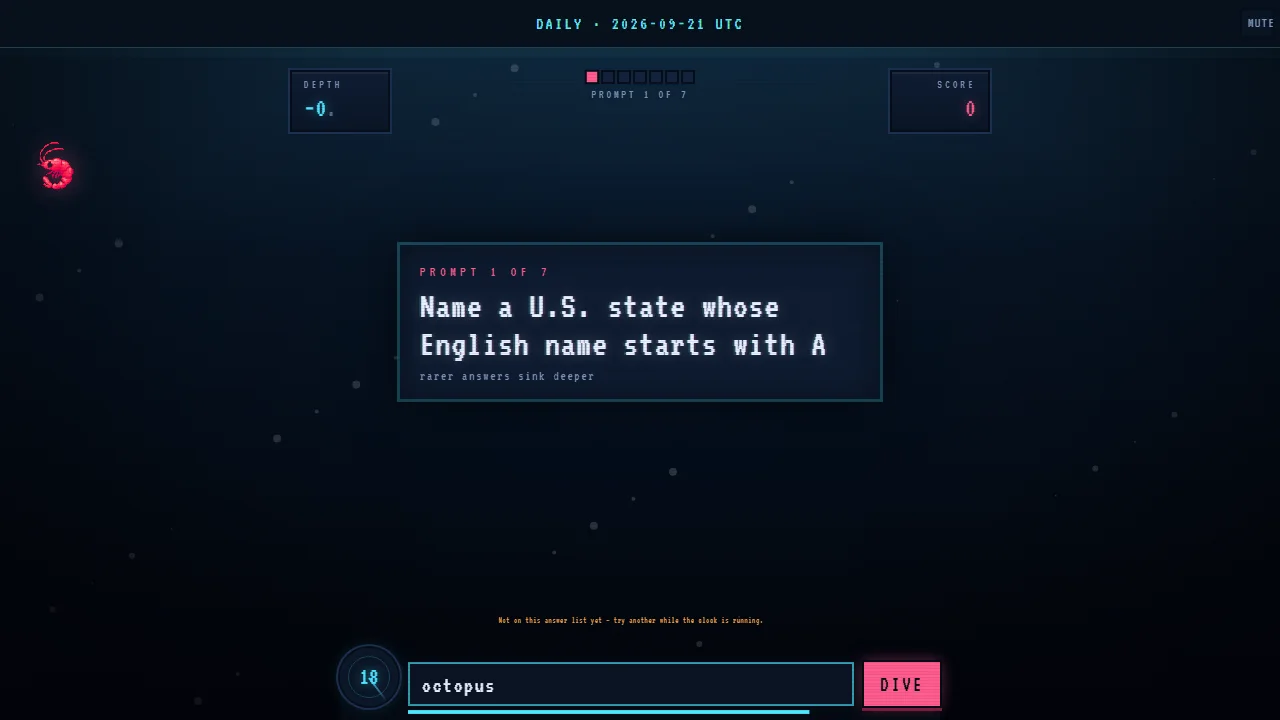
| Rejected answer | Not-on-the-list message while the clock continues | Replace it with the prepared safe answer |
| Final screen | Seven results, total score, depth, and comparison | Review the whole run instead of one highlight |
Before Begin Descent: prepare the screen and keyboard
Begin Descent is the real commitment point. We do not press it while deciding between portrait and landscape, changing keyboard language, or opening display controls. A Daily Dive only takes a few minutes, yet the prompts arrive fast enough that a small setup problem can consume half a turn. On desktop, click once inside the game so the embedded player owns the focus. On a phone, check that the page is at a comfortable zoom and that the browser bar is not covering the lower controls.
A one-minute preflight that protects the run
- Wait until the actual Krillion title screen appears; the site cover and Play Now button are not the game itself.
- Choose normal view or Webpage Fullscreen before starting. The view changes presentation, not the questions or scoring.
- Use the keyboard layout in which you can spell proper names quickly, and turn off aggressive autocorrection if it keeps rewriting uncommon words.
- Put the device on a stable connection and close overlays that might steal focus.
- Set aside roughly five uninterrupted minutes. Looking away for one notification can cost an entire prompt.
Read a Krillion prompt inside the 25-second clock
We read from the category outward. First identify the noun the game wants: country, character, product, animal, literary device, team, food, or event. Then collect every qualifier around it: a starting letter, date, speed, franchise, location, current or former status, technical versus culinary meaning, or an explicit exclusion. Only after that do we recall answers. Reversing this order makes the first familiar word feel correct before we have finished reading.
| Clock | Player task | Stop condition |
|---|---|---|
| 25–20 seconds | Read the complete category and underline the decisive qualifier mentally | We can state in one phrase what counts |
| 20–13 seconds | Recall a safe answer and up to two alternatives | Three legal candidates are enough |
| 13–8 seconds | Compare rarity against confidence | Discard anything that needs an argument |
| 8–5 seconds | Type the conventional name and proofread decisive letters | The input matches the intended answer |
| 5–0 seconds | Submit, or use the fallback after rejection | Do not finish with an answer still in the box |
The timing is a guardrail, not a rhythm game. A closed prompt should be answered sooner because its legal set is small. A broad prompt such as a food served on a stick may justify a few more seconds of recall. What never changes is the five-second commitment line: once the clock reaches it, a safe answer already in hand is worth more than another speculative memory search.
Build a three-candidate shortlist for Krillion
The shortlist is the simplest way to prevent both bland answers and empty boxes. Candidate one is the automatic safe response. Candidate two moves one ring away from it. Candidate three is a second valid alternative, not an obscure fact we barely remember. For a theme-park chain, that might mean Six Flags first, Legoland second, and a regional chain third. For a fictional robot, the headline mascot may be first while a supporting character such as Rosie from The Jetsons becomes the stronger second choice.
Run four filters before choosing the rarest candidate
| Filter | Question | Reason to reject a candidate |
|---|---|---|
| Type | Is it exactly the kind of thing requested? | It is related to the topic but belongs to another class |
| Qualifier | Does it meet every letter, era, place, status, or property? | One small condition fails |
| Canonical name | Would an ordinary reference list it under this wording? | It relies on a nickname or explanation |
| Typing confidence | Can we spell it before the clock closes? | The decisive letters are uncertain |
After testing this routine, we found the middle candidate wins more often than the heroic third one. It is far enough from the first instinct to escape the largest crowd, but familiar enough to survive the category and spelling checks. Save the risky third candidate for prompts in a subject we genuinely know well. Specialist confidence is useful; vague familiarity is not.
Submit cleanly and recover from Krillion answer rejection
Type the shortest standard form that clearly identifies the answer. Explanations do not add rarity and can make matching harder. Watch the field on mobile because autocorrect may replace a proper noun after we have visually moved on. Then use the on-screen Dive control or the supported keyboard submission and look at the game’s response, not merely the fact that a key was pressed.
Decide whether the problem is wording or category
A rejected proper name can sometimes be repaired with its standard full form, but a category error needs a different answer. The screenshot shows octopus entered for a state prompt. Changing punctuation or resubmitting OCTOPUS cannot help. The correct recovery is to erase it and use Alabama, Alaska, or Arizona while time remains. The shortlist matters here because the backup was chosen before the error appeared.
| Feedback | Meaning | Immediate response |
|---|---|---|
| A tier and points appear | The answer was accepted | Read the tier once and prepare for the next prompt |
| Not on this answer list; clock still moving | The entry was not recognised as valid | Use the safe candidate now |
| Nothing changes after typing | The field may not have focus | Tap inside the field; do not reload mid-prompt |
| Clock closes the route | The prompt ended without a scoring answer | Stop editing and reset mentally for the next one |
A complete seven-prompt Krillion run
A recorded Sunday Wildcard run is useful because it contains ordinary decisions rather than seven perfect answers. The player begins with a Google product, avoids Gmail and Sheets, tries Google Ads, and receives a modest result. On an animal above 40 miles per hour, falcon is valid but not rare. The grain prompt finally produces the stronger buckwheat answer and a Rare result worth 60 points. That sequence shows why a run must be judged across all seven prompts: two common answers do not prevent a later good retrieval.
| Prompt | Played answer | What happened | Better lesson than memorising the answer |
|---|---|---|---|
| Google product | Google Ads | Accepted but not especially rare | Secondary products are useful, but the crowd may know them too |
| Animal above 40 mph | Falcon | Accepted and common | A valid broad label can be crowded; a specific bird may score better |
| Grain or cereal crop | Buckwheat | Rare, 60 points / 600 m | Everyday specialist knowledge can be both safe and uncommon |
| Avatar: The Last Airbender character | Aang | Accepted at the common end | Limited franchise knowledge calls for the safe lead character |
| Country containing G and A | Ghana | Accepted but common | Longer valid countries were revealed later, but spelling time matters |
| Theme-park chain | Six Flags | Plankton, 10 points | The fallback saved the prompt after recall stalled |
| Literary device | Irony | Plankton, 10 points | A fast basic answer is better than timing out in a weak category |
The player also demonstrates a sound emergency habit on the theme-park prompt: when a less obvious chain will not come back in time, Six Flags is typed and submitted near the deadline. It earns only ten points, but it keeps the run complete. On a later review screen, Legoland appears as a 30-point alternative. That comparison is actionable: next time, move one rung beyond the first chain only if the second name arrives cleanly.
What we would not copy is waiting until the last second as a standard tactic. It worked on Six Flags, but left no room for typo recovery or a rejected match. The run also shows that knowledge gaps are local. Not knowing supporting Avatar characters does not justify gambling on the next country prompt. Each new screen gets its own risk decision.
Read Krillion results, ranks, and dive depth
Krillion uses six fixed visible tiers: Plankton is 10 points, Too Clever 15, Schooler 30, Rare 60, Deep Cut 85, and One in a Krillion 100. The final depth is the total score multiplied by ten. Seven Schooler answers make 210 points and 2,100 metres. A mixed run of 10 + 10 + 60 + 10 + 15 + 10 + 10 makes 125 points and 1,250 metres. The arithmetic is simple; the useful part is locating where points were lost.
| Result question | Useful interpretation | Bad interpretation |
|---|---|---|
| Did all seven prompts receive an answer? | Completion and timer control are stable | Every accepted answer was strategically good |
| Which valid answer was most common? | That category has room for a one-ring upgrade | The answer was factually wrong |
| Which entry was rejected? | Check category, qualifier, spelling, then list coverage | The player must be broken |
| Which answer earned the best tier? | The retrieval route worked in this response pool | That word will always be equally rare |
| What should change tomorrow? | Choose one repeatable habit | Memorise every revealed answer |
For deeper score planning, use the dedicated scoring and rare-answer guide. For a blank player, missing keyboard focus, or mobile layout trouble, use the loading and input guide. Keeping those subjects separate matters: basic play is about making seven clean decisions, while score optimisation and browser recovery each need their own diagnostic tools.
How to Play Krillion FAQ
How many prompts are in a Krillion Daily Dive?
There are seven open-answer prompts. Each one is timed separately, and the final result combines the points from all seven.
How long do we have for each Krillion answer?
The live prompt gives 25 seconds. Read the category first and treat five seconds remaining as the point to submit the safest valid candidate.
Do answers need to be complete sentences?
No. Use the shortest conventional name that clearly matches the prompt. Extra explanation creates matching and typing risk without improving rarity.
Can we try again after Krillion rejects an answer?
Yes when the rejection message appears and the clock is still moving. Replace the entry with the prepared fallback instead of repeating the same category mistake.
Should a beginner chase One in a Krillion every time?
No. Complete all seven prompts first. Upgrade the obvious answer when a clearly valid alternative arrives quickly, and accept a safe response in weak categories.
What is the difference between Krillion score and depth?
The six rarity tiers award points. At the end of the run, the point total is multiplied by ten to produce the displayed depth in metres.